
Filmstrip Projectors
and Viewers
High-quality filmstrips (i.e. those made from a contact copy of the negative) only required a relatively small light source to produce sharp images on a screen up to 2m in size with a lens at focal length of around 8cm. This meant that the filmstrip-only-projectors could be much smaller than lantern slide projectors - and above all, much cheaper. The first filmstrip projectors by the French company Pathé and the American companies Brayco and Picturol were sold in the 1920s. The Dresden-based company Filmdienst Jost & Co. manufactured filmstrip projectors from the early 1920s on as well. The Deutsche Evangelische Filmdienst offered the devices primarily to pastors for use at community and educational gatherings of their churches, even outdoors if necessary.

In the 1930s, combined filmstrip and slide projectors were produced under the company name Filmosto (Dresden) in Germany. A switch allowed to change between lantern slides, small film slides and filmstrips. Other companies offered filmstrip carriers for their lantern slide projectors that could be changed if needed. In England, there were projectors that could project filmstrips as rolls or as cardboard-framed strips, such as MiniCine. Small cheap filmstrip projectors made from rubber or plastic brought popular comics, such as from Disney, into private homes. In Germany, the last projectors capable of showing filmstrips were manufactured in the GDR at the end of the 1970s, mainly for export to East-European countries.
A few early filmstrip projectors made in Germany:
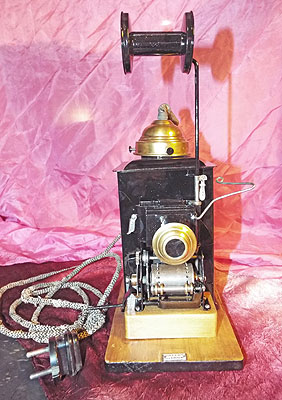


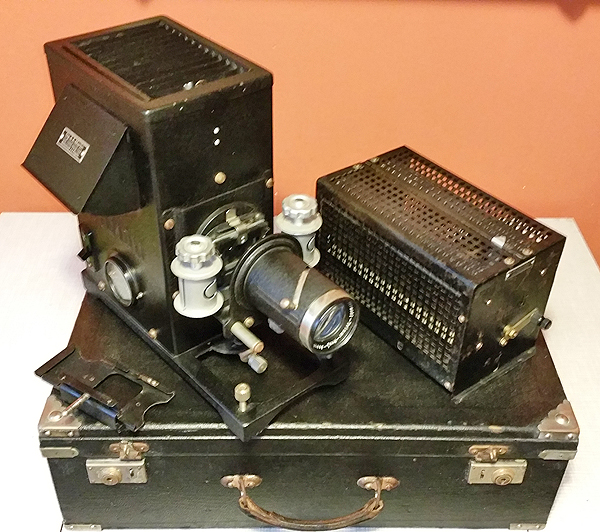


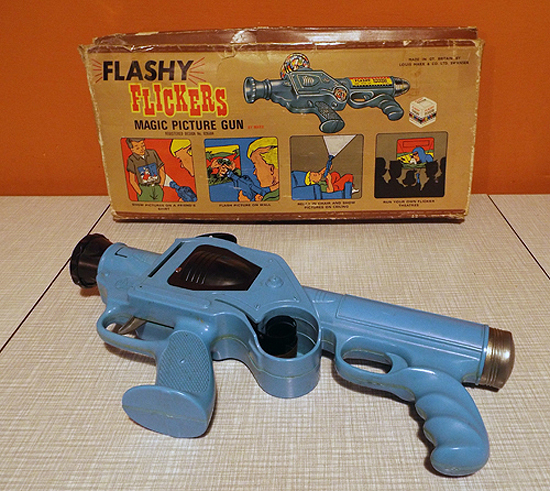
There were also models with integrated record- or tape player. New ways to protect the fragile filmstrip were searched. The Aspectomat, made in GDR since 1972, used little plastic boxes to house the film. This projector also used a remote control and automatic transport. A lot of projectors for kids had space age-design.
Projectors from the GDR:


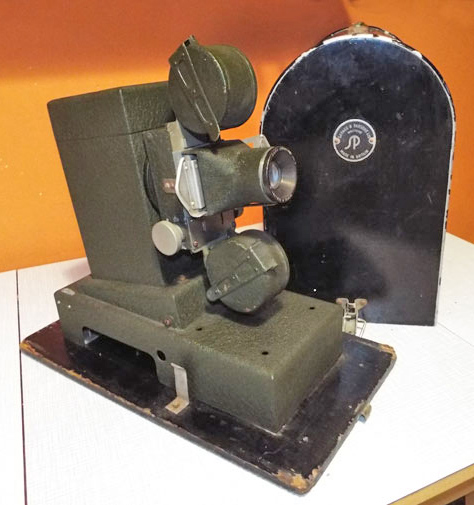

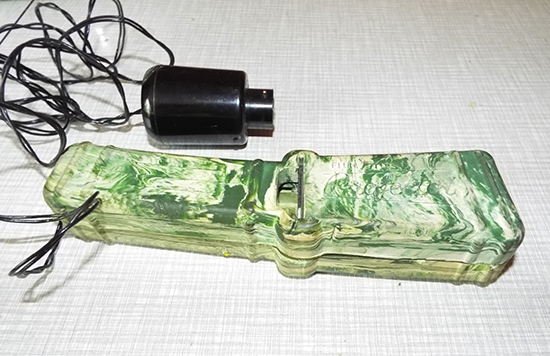
Not all filmstrips were meant to be projected. Pathé-filmstrips (France) could originally only be used with a tiny viewing device. Tru-Vue-stereos (USA) only funcioned with the respective Viewer. The 16mm filmstrips by Peep Scope (England) were for a little viewing device as well. Just like in the Pathéorama, the filmstrip roll was placed on one side of the capsule and then transported by a little wheel in front of the lense to the other side.
>> See an advertising for Pathéorama and its filmstrips from 1929! (Le Cinéma chez soi, Nr. 28, Feb. 1929)<<
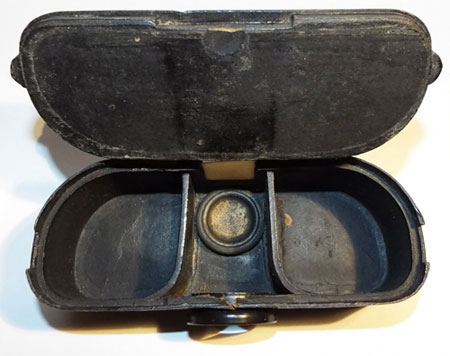
A Pathéorama, opened. In the middle, the little rubber wheel for filmstrip transportation, in front, the lense, in the back, the light window. Viewers like this one had to be held against a light source.
The "Shortstrips" by Encyclopedia Britannica (USA) sat together with their texts and questions in a plastic sheet and were meant to be placed like that in a handheld viewer.
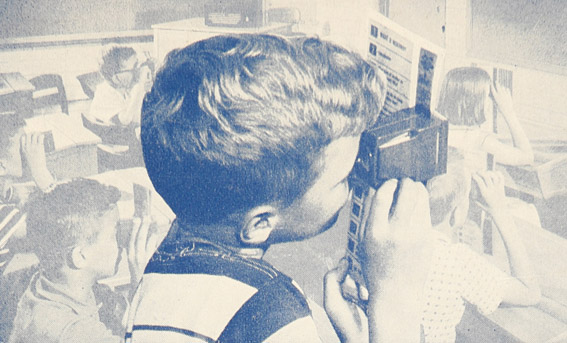
Children using the "Shortstrips"
The "Show'n Tell" (USA) units consisted of a record and a 16mm filmstrips that had to be placed in a device looking like a tv-set with a record placer on top. The synchronized phonoviewer was produced first by General Electric. "Show'n Tell" units were sold until the 1980s.