
What is a filmstrip?
A filmstrip is a series of singular still images placed on a film or plastic strip, or fixed in a cardboard frame. The sequence of the images cannot be changed. In the last 100 years, various terms have been in use to describe this medium: film-slide, filmstrip, Picturol, film fixe (France), Stehfilm, Bildband (Germany). In Eastern Europe, "Diafilm" is used. Until the 1920s, a "filmstrip" or "Bildband" was dominantly used to describe a cinematic film with moving images.
---> WATCH A PRESENTATION (mp4-Video)
History
The photographic lantern slide, invented in the second half of the 19th century, proved to be an advancement of the previously painted lantern slides, as the photography was seen as accurate carrier of real objects and situations. To create a positive photographic slide, a previously developed negative plate was copied onto a (positive) slide plate using various methods. Re-developed, provided with a protective cover glass, and framed, a projectable lantern slide with an average size of 8.5x10 cm was created. However, the material costs (chemicals, glass plates) and the necessary handywork made glass lantern slides an expensive affair. Elementary schools, middle class households and poor church communities could barely afford them, and even at universities, a constant fight to get money for slides had to be waged.
The invention of celluloid film at the end of the 19th century changed the world of image projection fundamentally. First only used in cinematographic "moving" films, very soon possibilities for its application in "still" photography (that, so far used glass plates) were tested. Those works resulted in the first 35mm camera "Leica", and in the filmstrip. Maybe the French media giant Pathé invented the filmstrip in 1921. Howeve, at the same time, the U.S.-American company StillFilm Inc., based in Los Angeles, produced 55mm filmstrips, and in Germany, early material by Liesegang has been found. The U.S.-American company Tru-Vue developed stereo filmstrips from 1933 on, which could only be watched with an according viewer. Due to material scarcity after World War II, the French enterprise Mundus produced filmstrips on 16mm film.
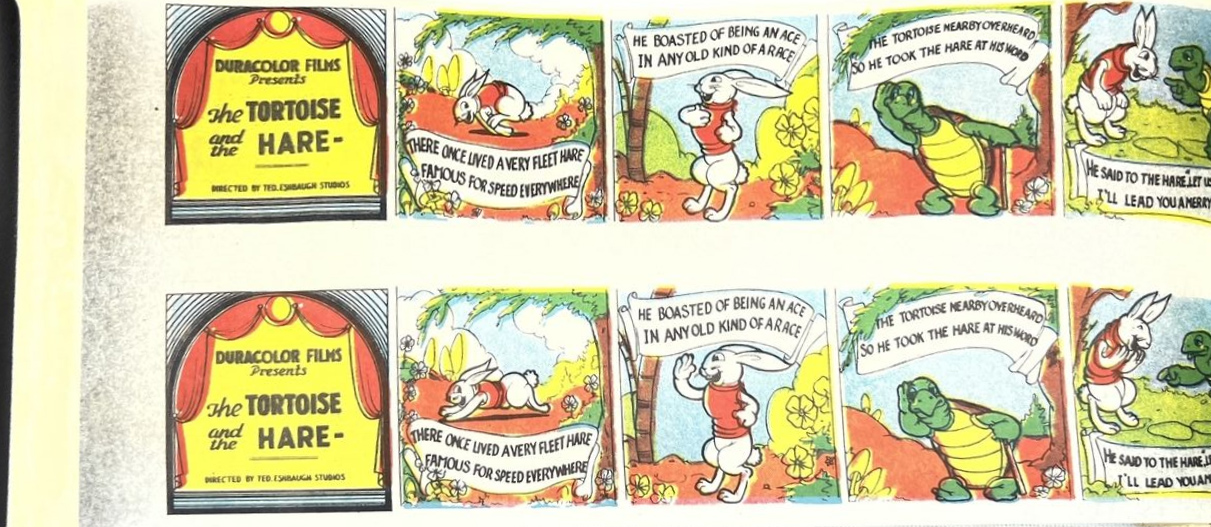
From the 1950s on, toy projectors often had filmstrip series with unique filmstrip format and size, which was distributed only and could be viewed only with the respective projector. A specialty were the Duracolor strips for Durable Toys double-lense projector. Those, and similar filmstrips, created the illusion of an animated film in the sequence of alternated projection of upper and lower filmstrip.
Many publishers (list as per August 2025), among them huge professional lantern slide publishers, but also small family enterprises, charitable organisations, newspapers, political parties and enterprises offered filmstrips accompanied by texts or records. Cooperations between educational institutions and companies formed. Privately photographed series could also be send in and developed into a filmstrip - such as from a pilgrimage or rallies of a party.
From the mid-1920s on, multiple newspapers report of filmstrip-viewing events, with enthusiastic crowds attending.
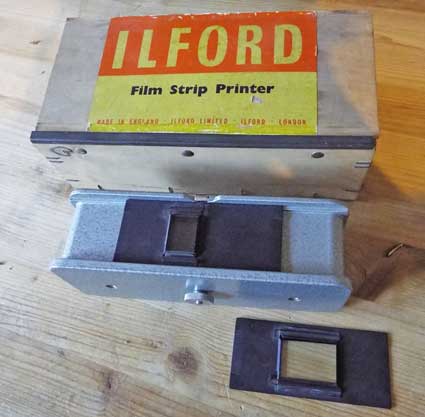
In Germany, the filmstrip was banned from schools in 1940. In other countries, it was in use until the 1980s. The Hungarian enterprise Diafilm still produces filmstrips - which are in high demand in the country! At least from the 1950s on, everyone could made his/her filmstrips at home using small contact printers such as this Ilford.
Filmstrip sizes and sprocket holes

Tru-Vue stereo-filmstrips with normal and 4,5cm sprocket holes

Flashy Flickers - filmstrip

Duracolor Dual Lense - filmstrip
In Germany, the old single frame size was replaced by the new double frame or "Leica" from the 1930s on. Read here informations from a publisher about the new double frame filmstrips.
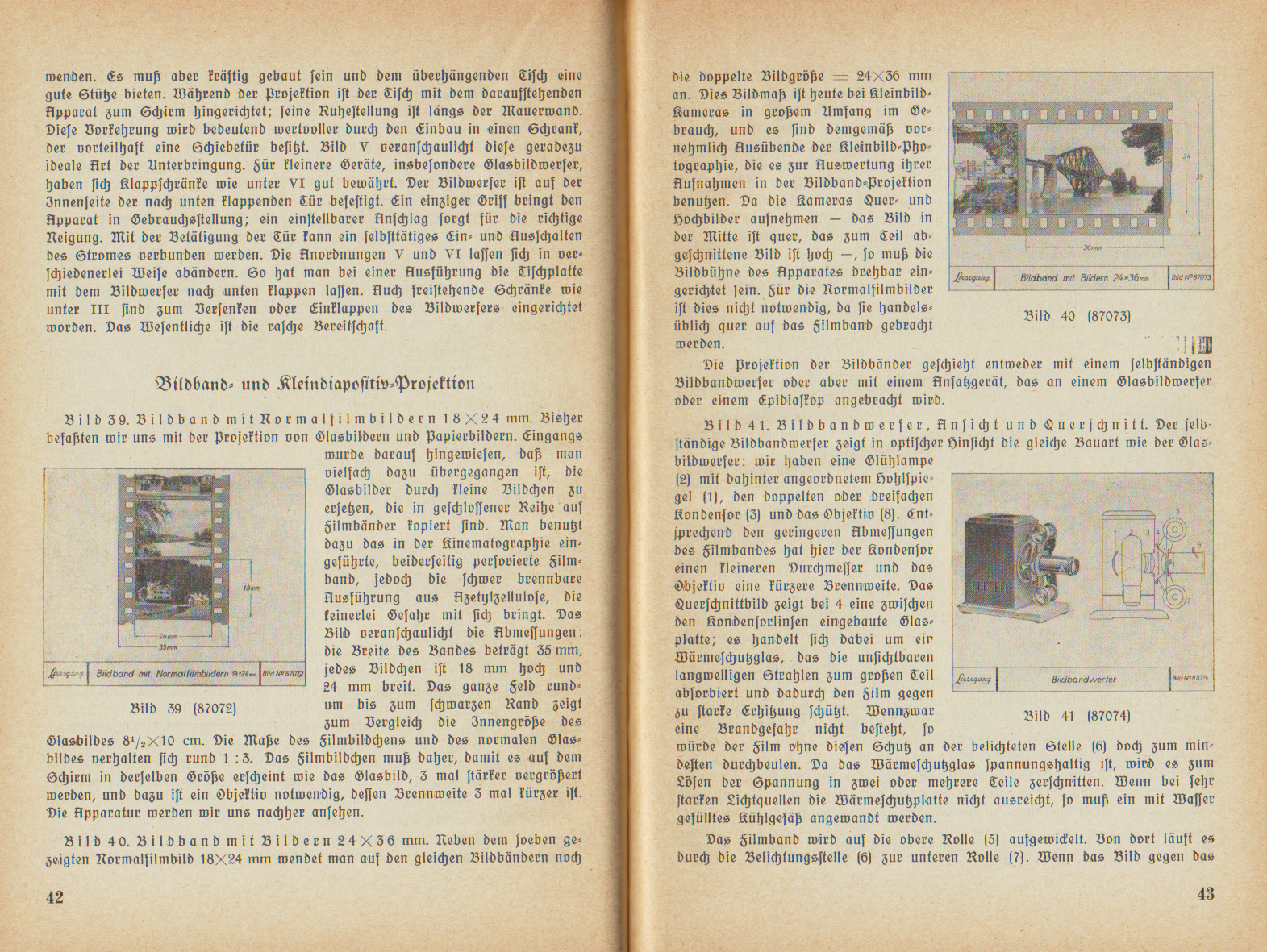
Double Frame and Single Frame explained (Ed. Liesegang: Einführung in das Wesen und die Wirkungsweise des Stehbildwerfers, Düsseldorf 1936)
Double-frame "Leica" - filmstrip with black inserts, that allowed the turning of the filmstrip carrier unnoticed

Filmstrips could come as a roll, and placed in a cardboard, tin, or plastic box. Or they could come as a flat stripe like the Film Stips products, or inserted in a cardboard or plastic frame.
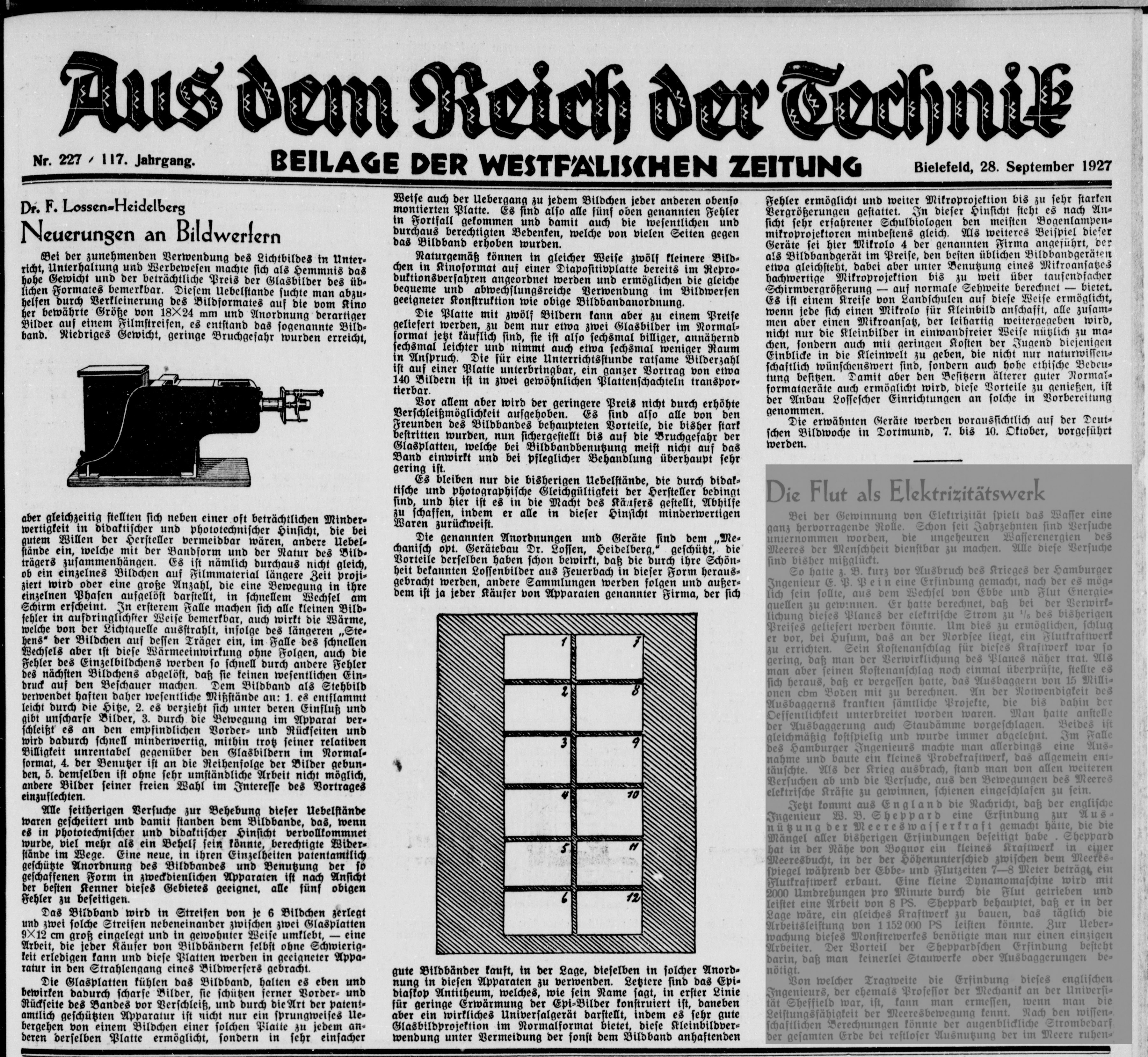
A filmstrip did cost only a fraction of a lantern slide series. Moreover, it was lightweight and multiple filmstrips could easily be transported to a location, while boxes containing the same amount of lantern slides would already have needed transportation aids. The fixed order of the individual images on the filmstrip was seen as an advantage (nothing could be mixed up or get lost), but as an impediment to teaching as well (the teacher could not customize). In contrast to a lantern slide, which (usually) was well protected by its cover glass, a filmstrip was exposed to environmental influences without protection. Scratches appeared, the more often ist was used and are now an indication for the frequence of its use. Due to its small size, the image quality of filmstrip was not as good as that of an 8.5 x 10 cm photographic lantern slide. In addition, many low quality filmstrips were not produced by contact copying, but reproduced from photographic prints or even postcards. Half tone dots, weak contrast, blurry images are the results.
>> Read here a critic of the filmstrip's quality and suggestions to improve (from: Westfälische Zeitung Nr. 227, Beilage, 28. Sept. 1927) <<
Color
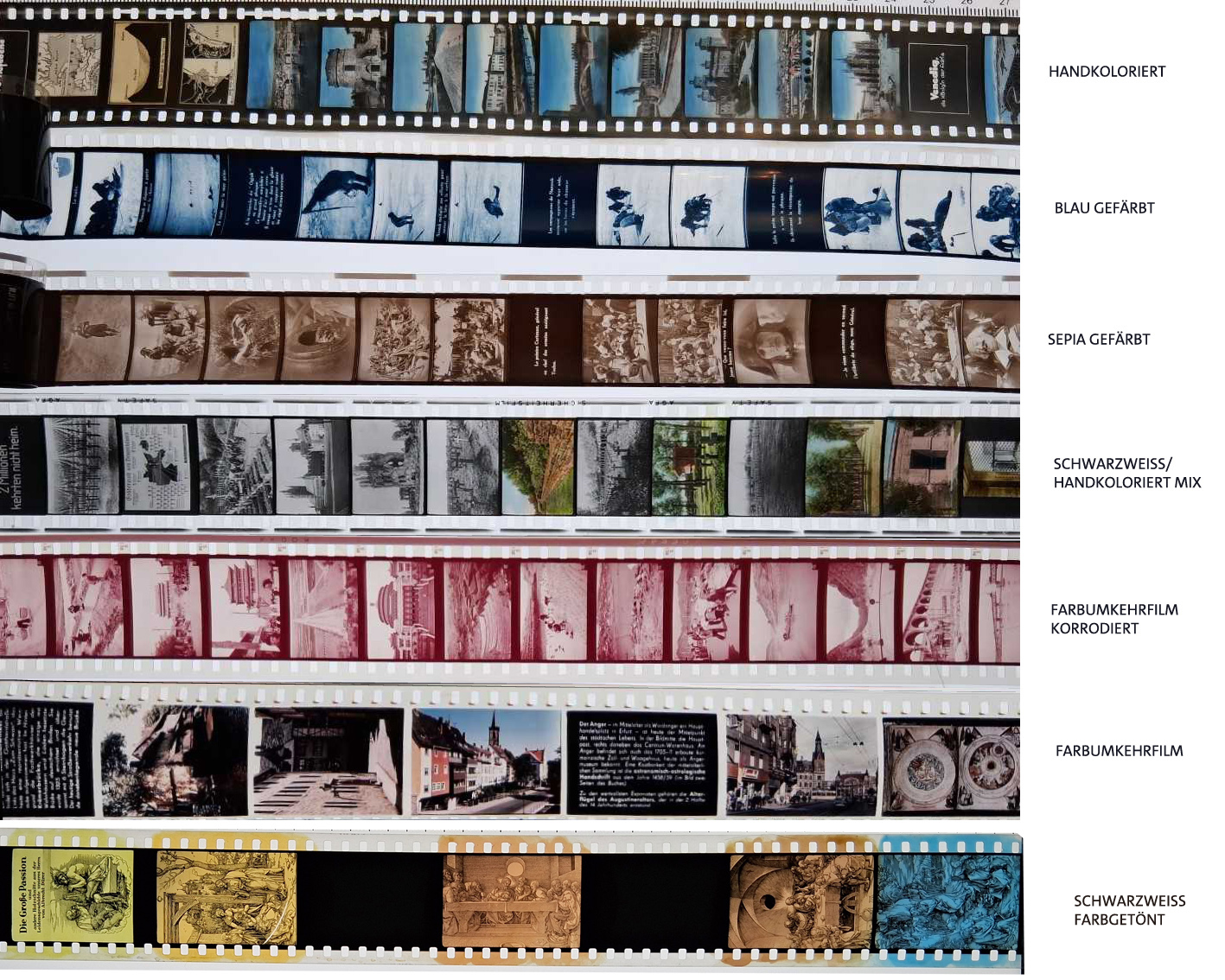
Filmstrips on color-reversal film existed at least since 1938. One of the early German publishers was Johann Eibl in Munich.
>> See a filmstrip by Johann Eibl on color-reversal film <<
Despite the small size of the images, some publishers offered to have them colored (by hand or by the use of stencils). This was still offered in the 1950s. The price difference was huge: Ascop (Dresden, GDR) offered its fairy tale strips with 15 images for 3 DM in b/w, and for 10,50 DM in the hand-colored version.
From a German documentation (2018) about the filmstrip company Mikrolux (GDR):